Terminal blocks
Introduction
Terminal blocks are used in Clever Transfo and Clever Inductor applications as output terminals when current and other parameters allow their use. Note that this table is not suitable for Clever Small-T and Clever Small-I applications, which use the “terminal blocks ST” table. The terminal blocks can be attached directly to the clamping profiles (terminal blocks in lists) or on a rail, which in turn will be attached to the profile, as in the drawing above. There are various types of terminal blocks and you can distinguish among them by the field Code.
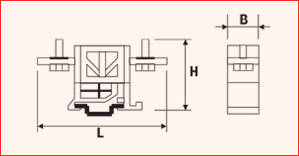
Table fields (Terminal blocks)
- Section in mm2: usable section. Refers to the maximum section of the conductor that will be inserted into it.
- Width: the thickness of the individual terminal block (Dimension B in the drawing above).
- Height: height of the terminal block (Dimension H in the drawing above).
- Length: the maximum length of the terminal block (Dimension L in the drawing above).
- Hole diameter: conductor entry hole diameter.
- Code: acronym by which the type of terminal block is identified.
Example:
Binary = Terminal block on Omega rail
If other terminal block types are to be used during customisation, please contact us for the choice of the code. - Rating current A: maximum supported current.
- Type: abbreviation by which the terminal is identified (can be the supplier's abbreviation).
- Article: to select the material, use the article code of your management system. This value will allow the applications to retrieve the description and unit cost into the table Material Unit Cost by importing the list of materials available in your warehouse.